Exercitation ullamco laboris nis aliquip sed conseqrure dolorn repreh deris ptate velit ecepteur duis.
Close
Get in touch
[contact-form-7 id="5" title="Sidebar Newsletter"]THE BUSINESS OWNER’S RETIREMENT TRAP
 Articles
For most salaried professionals, retirement has a predictable rhythm. They contribute to provident funds, invest in an NPS, build investment portfolios, purchase insurance, and gradually create a retirement corpus. While there are challenges, the path is generally well defined.
For business owners, however, retirement is a very different story. Ask an entrepreneur about retirement, and you’ll often hear the same response: “My business is my retirement plan.”
It sounds logical. After all, the business has taken decades to build. It generates income, owns valuable assets, employs people, and often carries significant goodwill in the market. Many entrepreneurs assume that one day they will simply sell the business, pass it on to their children, or continue earning from it without actively managing it.
Unfortunately, reality is often far more complicated. One of the biggest financial mistakes business owners make is confusing a successful business with a successful retirement plan.
The two are not always the same.
A BUSINESS IS NOT THE SAME AS WEALTH
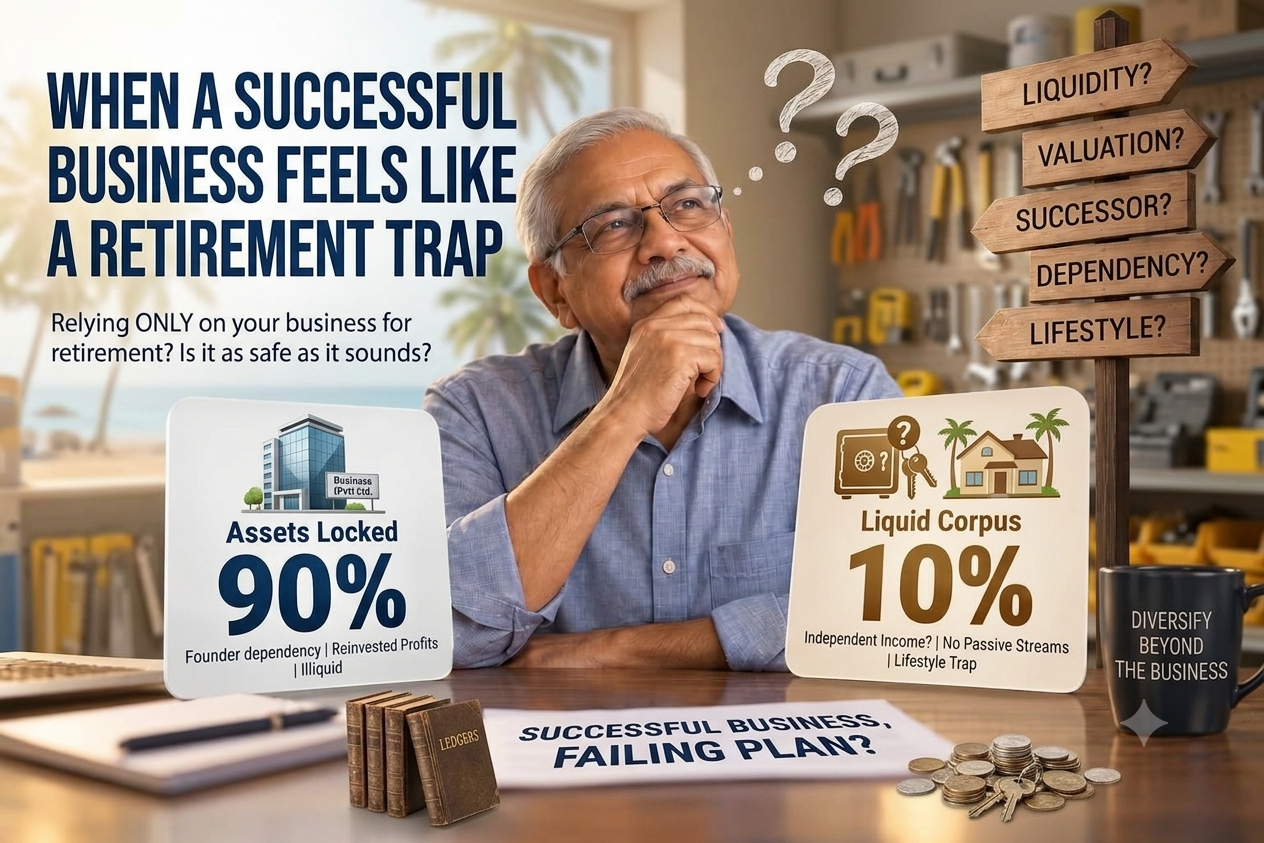
A business can be profitable and still fail to provide retirement security. Because a business is rarely a liquid asset. Unlike a mutual fund, fixed deposit, or listed share, you cannot simply decide to sell your business tomorrow and expect to receive its full value. Finding the right buyer takes time. Negotiating a fair valuation is challenging. In many cases, the business depends heavily on the owner’s reputation, relationships, and decision-making. Once the owner steps away, the value of the business may change significantly. In simple terms, your business may be worth a great deal on paper but generate very little personal financial freedom when you decide to retire.
THE SUCCESSOR PROBLEM
Many business owners assume that the next generation will naturally continue what they have built and that may have been true thirty years ago. Today, it is becoming increasingly uncommon. Children are pursuing different careers, studying abroad, joining multinational companies, or choosing professions that align with their own interests. Even when they return to the family business, they may not have the same passion or entrepreneurial mindset that built it. There is nothing wrong with that and every generation deserves the freedom to choose its own path. The mistake lies in assuming they will automatically take over.
Without proper succession planning, a thriving business can suddenly face uncertainty when the founder retires. Employees become anxious, customers lose confidence, and business continuity is threatened. But retirement should never depend on assumptions.
THE LIFESTYLE TRAP
Business owners often reinvest everything back into the business. Every additional profit becomes another office, another machine, another showroom, another expansion. While this fuels growth, it often comes at a cost. Personal wealth remains closely tied to business wealth. On paper, the entrepreneur appears extremely successful. In reality, much of their net worth is locked inside the business. If an unexpected health issue forces early retirement, the family may discover that despite owning a successful enterprise, they have limited personal investments capable of generating independent income. A business should create wealth for the owner and not become the owner’s only source of wealth.
In my experience, Goa has thousands of family-owned businesses that have been built with dedication over decades. Restaurants, hotels, retail establishments, manufacturing units, trading firms, and professional practices have created livelihoods for generations. Yet many of these businesses face the same challenge. The founder continues to make every important decision, customers know the owner personally and suppliers trust the owner. The business functions exceptionally well but largely because of one individual.
This creates what I call founder dependency.
If a business cannot run without its founder, it becomes hard to sell and even harder to step away from. True business success is achieved when the business continues to thrive even when the founder chooses to step back.
RETIREMENT IS MORE THAN AN EXIT
Many entrepreneurs think about retirement only when they are ready to stop working. By then, important decisions become rushed.
- Who will manage the business?
- Should it be sold?
- How should the proceeds be invested?
- How will retirement income be generated?
These questions deserve answers years before retirement, not months before it. An effective retirement strategy for business owners involves much more than exiting the business. It includes building investments outside the business, creating passive sources of income, reducing dependence on active earnings, preparing successors, and ensuring that family wealth is diversified rather than concentrated in a single enterprise.
YOUR BUSINESS IS A VEHICLE, NOT THE DESTINATION
Every entrepreneur begins with a dream, the business is the vehicle that helps achieve it Somewhere along the journey, however, many begin treating the vehicle as the destination itself. The purpose of building a successful business is not merely to create turnover, profits, or assets. It’s true purpose is to provide financial freedom, security for the family, opportunities for future generations, and the ability to choose when and how you wish to work. If stepping away from your business feels financially impossible, then your business may own you more than you own it.
THE REAL MEASURE OF SUCCESS
As financial consultants, we often celebrate businesses that grow year after year. But perhaps there is a better measure of success.
- Can the business survive without you?
- Can your family remain financially secure if you step away tomorrow?
- Can your retirement be funded without depending entirely on the future value of your business?
These are uncomfortable questions, but they are also the most important ones. Building a successful business is an extraordinary achievement but building a successful life beyond the business is even greater. After all, the ultimate goal of entrepreneurship is not simply to create a business that lasts a lifetime. It is to create a lifetime of financial independence that lasts long after the business no longer needs you.